
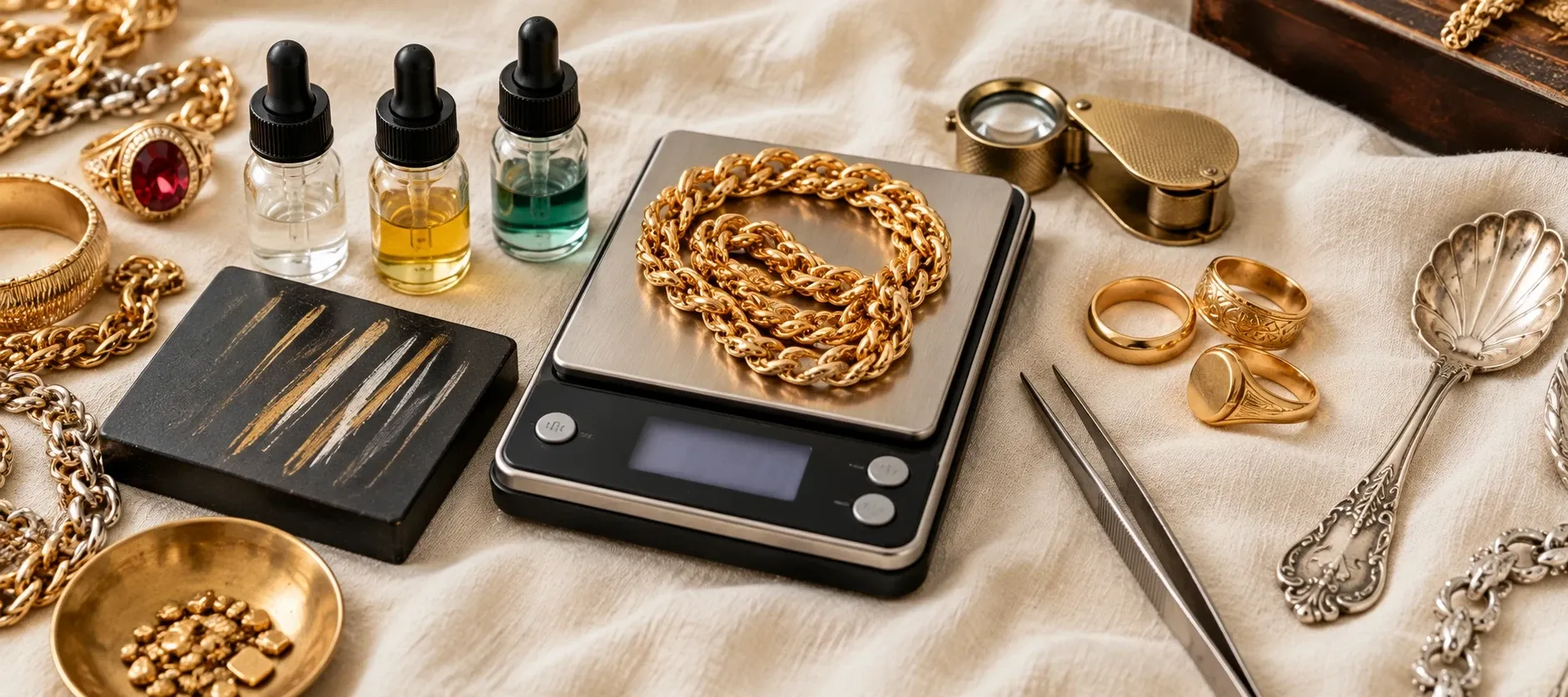
When you bring something in, we evaluate it at the table in front of you, make you an offer, and tell you how we arrived at it. This page explains how that works, so nothing about it is a mystery.
Gold and silver: market price, purity and weight
For most gold and silver, an offer is based on three things.
- The daily market price. Gold and silver trade every business day, and the price moves every day. We work from that day’s market price, so an offer on one day can be different from an offer on another.
- The purity. Very little jewelry is pure gold. It is mixed with other metals to make it stronger, and the karat mark tells you how much of it is gold. Sterling silver is 92.5% silver.
- The weight. We weigh your items on a scale you can see. Precious metals are weighed in grams, pennyweights or troy ounces. A troy ounce is about 31.1 grams, a little heavier than an ordinary kitchen ounce.
Together, those three numbers give the value of the pure metal in a piece. This is often called its melt value.
| Karat mark | Sometimes stamped | Gold content, roughly |
|---|---|---|
| 10K | 417 | 42% |
| 14K | 585 | 58% |
| 18K | 750 | 75% |
| 22K | 916 | 92% |
| 24K | 999 | 99.9% |
For example, a 14K chain that weighs 10 grams holds about 5.8 grams of pure gold. That amount, multiplied by the day’s price for pure gold, is the chain’s melt value.
Why our offer is less than the price on the news
The gold and silver prices quoted on the news and online are for large bars of pure metal traded between dealers. Jewelry, flatware and coins have to be tested, refined and sold on before they are worth that, and like every buyer, our offer is below that figure. We will show you the purity and weight we used, and tell you how we arrived at the number.
We test in front of you
We test the metal at the table, in front of you, and show you the result.
A karat or sterling stamp is a good first clue, but stamps wear away, some are wrong, and some real gold and silver is not marked at all. Testing tells us what a piece actually is, and you see the same result we see.
When a piece is worth more than its metal
For some pieces, melt value is only the starting point. These things can add value above melt:
- Stones. Diamonds and other gemstones set in jewelry.
- Brand. Watches and jewelry from well-known makers.
- Condition. A piece in good, wearable condition, or a coin or banknote that has been well kept.
- Rarity. Some coins and banknotes are worth more to collectors than their metal or face value.
For every piece, we tell you which basis we used: the metal alone, or the piece as a whole.
The decision is yours
An offer is only an offer. You are free to decline it and take your items home. The evaluation costs nothing, whether you sell or not.
If you accept, you are paid before you leave.